Armenia
We went to Armenia twice, both times in the middle of winter. The first trip was in November–December 2017; the second came around the New Year of 2020. Both times we travelled together.
What started as an easy destination to reach from the UAE became a place we genuinely enjoyed returning to. The two journeys also gave us a chance to see Armenia in winter, when its mountains, lakes and towns take on a completely different character.
Why Armenia
The original attraction was simple: while I was living in the UAE, an Indian passport holder with a valid UAE residence permit could enter Armenia visa-free. It was remarkably easy to book a flight and go. That ease was enough to make Armenia an obvious choice — and, two years later, an obvious place to return to.
But the practical reason for choosing Armenia quickly became secondary to the experience itself. We discovered a country with an ancient Christian heritage, dramatic landscapes, mountain resorts and, most unexpectedly for us, a surprisingly strong connection with India.
Yerevan
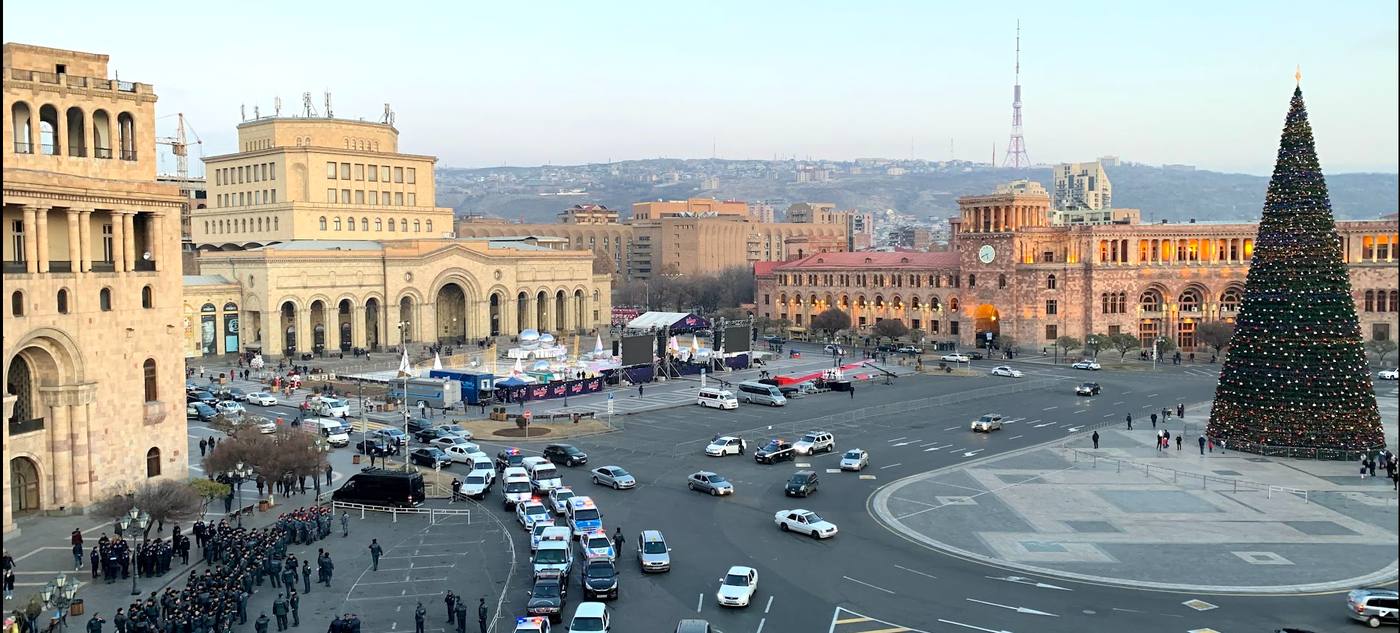
Yerevan became our base on both visits. We stayed at the Marriott near Republic Square, which was an excellent location for exploring the centre on foot and returning easily after a day out in the cold.
Republic Square is one of the defining spaces of the Armenian capital, surrounded by some of Yerevan’s most important civic buildings. For us, though, it also became the place where many of the small encounters of the trip happened — walking around, browsing shops and meeting people.
There was another unexpected connection with India. Yerevan had many Indian students, particularly students studying medicine. On one occasion an Indian student staying at the hotel helped us bargain in a local shop because he could speak Armenian. It was one of those small travel moments that makes a foreign place feel a little less foreign.
The warmth of the Armenian people was probably what stayed with me most. Even in the cold of winter, people were remarkably welcoming. Around Republic Square, shopkeepers who discovered that we were Indian often became especially warm and friendly. There seemed to be a genuine affection for Indians, perhaps helped by their familiarity with Bollywood.
Lake Sevan
Lake Sevan was one of the places that made Armenia feel much larger than the map suggested.
It is one of the world’s high-altitude freshwater lakes and Armenia’s largest lake. In winter, the landscape around it becomes especially stark: water, mountains, open sky and cold air creating a sense of enormous space.
For us, Sevan was less about doing a particular activity and more about experiencing that landscape. After the bustle of Yerevan, standing beside the lake felt quiet and expansive.
It also helped explain why Armenia works so well as a winter destination. The country can move very quickly from an urban setting into mountain and lake landscapes that feel remote.
Garni and Geghard
Garni Temple and Geghard Monastery gave us two very different glimpses into Armenia’s long religious and cultural history.
Garni is particularly unusual because it is a surviving classical pagan temple in a country whose identity is so strongly associated with Christianity. Its setting above the Azat River gorge makes the visit about the landscape as much as the structure itself.
Geghard, by contrast, is a medieval Christian monastery complex partly carved into the surrounding rock. The combination of stone architecture and the natural gorge around it gives the place a very different atmosphere from Garni.
Visiting both on the same journey made the history easier to appreciate. Armenia’s past isn’t represented by one period or one style; it is layered across centuries.
Tsitsernakaberd
Tsitsernakaberd, the Armenian Genocide Memorial Complex, was a very different experience.
The memorial commemorates the victims of the Armenian Genocide, and the visit is difficult to approach simply as sightseeing. The starkness of the memorial and the silence around it create an atmosphere that stays with you.
It was deeply sad and sobering. Travel sometimes introduces you to beauty; sometimes it confronts you with history that is difficult to absorb. Tsitsernakaberd was very much the latter.
Tsaghkadzor — our first ski-resort experience
Tsaghkadzor became one of the happiest memories of our winter trips.
The mountain resort sits on the slopes of Mount Teghenis and is one of Armenia’s main winter tourism centres. We did not stay there, but took the ropeway up to experience the snow and the views.
For me, this was significant because I had always wanted to experience a proper ski resort. I had not managed to do that elsewhere, and Armenia unexpectedly gave me my first taste of it.
We weren’t serious skiers. We were tourists enjoying the cable car, the snow, the mountain scenery and the atmosphere of a winter resort. Sometimes a first experience does not need to be elaborate to become memorable.
Jermuk
Jermuk was another place that stood out.
Located high in the mountains of southern Armenia, Jermuk is known for its mineral springs and its role as a spa and health resort. The town sits amid forests and mountains, with the Arpa River gorge cutting through the landscape.
We saw the frozen waterfall, which looked particularly striking in winter. We also experienced the local mineral water, something that is deeply associated with Jermuk and has been used there for generations.
What I liked about Jermuk was that it felt less like a conventional sightseeing stop. The landscape, the water and the town’s identity as a mountain resort were all part of the experience.
Khor Virap, Areni and the Armenian landscape
We also visited Khor Virap, Areni Winery, Kecharis Monastery and the Haghartsin Monastic Complex.
Khor Virap is one of Armenia’s most recognisable monastery settings, with Mount Ararat forming the dramatic backdrop when visibility is good. The location makes it easy to understand why Armenian religious sites are so closely associated with the surrounding landscape.
Areni took us in a completely different direction. Wine is an important part of Armenian culture, and visiting a winery made the experience more tangible than simply seeing bottles in a shop. Armenian wine became one of the small pleasures we carried through both trips.
Kecharis and Haghartsin added yet more layers to the journey — medieval monasteries set in mountain environments, where the journey to the site is almost as memorable as the building itself.
Food
Being vegetarian made food one of the practical challenges. We managed with pizzas, salads and breads, but food was not one of the easiest parts of travelling for us.
It was never enough to spoil the journey. We had become quite good at adapting, finding something suitable and moving on. Travel has a way of teaching you that not every meal has to be perfect for the trip to be good.
What I would tell a first-time visitor
The people are kind. Do nothing to lose their trust.
Make time for Lake Sevan and Jermuk. Take time to explore local places rather than limiting yourself to the obvious sights. The flea markets are worth wandering through, particularly for handmade products. I remember handcrafted wooden chess boards in particular — the kind of thing that carries a little piece of the place home with you.
And leave some room for Armenian wine. A visit to Armenia should include some.
If travelling in winter, the mountain resorts are worth experiencing even if you are not a serious skier. For us, simply riding the ropeway at Tsaghkadzor and seeing the mountains covered in snow was enough.
Armenia and Chennai
Armenia also changed how I looked at a part of home. Chennai has an Armenian connection, including Armenian Street. After visiting Armenia and seeing something of the country’s culture and history for myself, that connection became much more tangible to me.
It was one of those small discoveries that travel gives you unexpectedly: you leave home thinking you are going somewhere completely foreign, only to discover that the destination has left traces back home as well.
Looking back
Armenia was never a destination we had spent years dreaming about. The first trip happened largely because getting there was easy. Yet it became one of the countries we liked enough to return to.
The two winter journeys gave us Yerevan, Lake Sevan, ancient temples and monasteries, the sombre history of Tsitsernakaberd, the snow at Tsaghkadzor, the frozen waterfall at Jermuk, Armenian wine and, perhaps most importantly, many small interactions with people who made the country feel welcoming.
Sometimes the best destinations are the ones you choose for a practical reason and then discover for a completely different one.