Amarnath
The invitation
In July 2005, I was working in Haridwar when an email arrived from Giriraj, a colleague from Bangalore.
He was planning a trip to Amarnath and wanted to know if I would like to join him.
I knew very little about the Amarnath Yatra. Growing up in Tamil Nadu, the pilgrimages I was familiar with were places like Tirupati, Rameswaram and Kashi. Amarnath was somewhere in the Himalayas, associated with Shiva and an ice lingam. That was about as much as I knew.
But I have never been very good at saying no to travel.
Religion wasn’t really the reason I said yes. Travel was.
I was 29, unmarried and working in Haridwar. The opportunity to travel into Kashmir and undertake my first Himalayan pilgrimage was enough.
Giriraj was coming from Bangalore. We decided to meet at Saharanpur.
I took a bus from Haridwar to Saharanpur and waited at the railway station for his train, the Shalimar Express. When he arrived, two colleagues from completely different parts of the country were suddenly travelling together.
Neither of us quite knew what we had signed up for.
Into Kashmir
The train journey was overnight. The coach was full of devotees heading towards the same destination. After spending the night sleeping on the train, we reached Jammu early in the morning.
From Jammu, our next challenge was getting to Pahalgam.
The buses were overflowing with pilgrims. There were simply too many people travelling towards the same place, and waiting for a regular bus did not seem like a sensible option.
The Tata Sumo became our solution.
We found a driver willing to take us to Pahalgam. Since the journey was going through Kashmir, Giriraj and I negotiated for the front seats. If we were going to spend hours travelling through the mountains, we wanted the view.
The journey took us through Anantnag towards Pahalgam.
By 2005, the Kashmir security situation was still very much a reality. We had heard about Army protection of the Amarnath Yatra, but hearing about it and experiencing it were two different things.
Near Anantnag, we reached an Army checkpoint.
The message was clear: civilian vehicles would not be allowed to continue that night. Pilgrims were to return to a transit camp and travel onward the following morning as part of the protected convoy.
The transit camp was a large FCI warehouse. Hundreds of pilgrims were already there, and there was hardly any space left.
Giriraj and I looked at the situation, then looked at our Tata Sumo.
The decision was easy.
We asked the driver whether we could sleep in the vehicle. He was initially concerned that the Army might inspect the vehicles during the night and question why passengers were sleeping inside. Eventually he agreed.
So that night, the Tata Sumo became our hotel.
It was late, we were tired, and somehow the five or six hours passed like two. I slept surprisingly well.
The next morning, the convoy moved towards Pahalgam, with Army vehicles at the front and rear and a long line of civilian vehicles carrying pilgrims in between.
For the first time, the scale of the operation became apparent. This wasn’t simply a trek into the mountains. It was a pilgrimage involving thousands of people, moving through terrain where security had to be taken seriously.
Pahalgam and the trek
Pahalgam itself wasn’t really a destination for us. It was the starting point.
There was chaos, crowds and the usual activity around the beginning of the Yatra. We didn’t spend much time there before starting towards Amarnath.
And that’s when we made our first mistake.
We carried our backpacks ourselves.
They hadn’t seemed particularly heavy when we packed them. On a Himalayan trail, they suddenly seemed much heavier.
The route from Pahalgam to Amarnath was about 32 kilometres, with a night halt around Sangam.
For much of the journey, the trail was a narrow mountain path. Occasionally we crossed stretches of glacier, and the landscape changed dramatically as we climbed.
The ponies followed a different route for much of the way, usually slightly below the main trail. At places the two routes merged, and watching the ponies negotiate the narrow sections close to the valley was enough to convince me that I had no interest in riding one.
After several hours of walking, the backpack had become the real problem. I was exhausted. Hiring a pony started looking increasingly attractive.
Giriraj wasn’t convinced.
We had come this far.
So we found a porter instead.
As it turned out, he was completing his own pilgrimage and was on his way back. He agreed to carry our backpacks.
Suddenly the trek became considerably easier.
Sometimes the smartest travel decision is simply knowing what weight you don’t need to carry yourself.
We continued walking. There was no comfortable hotel waiting at the end and no leisurely evening planned before darshan. The destination was the cave itself.
The cave
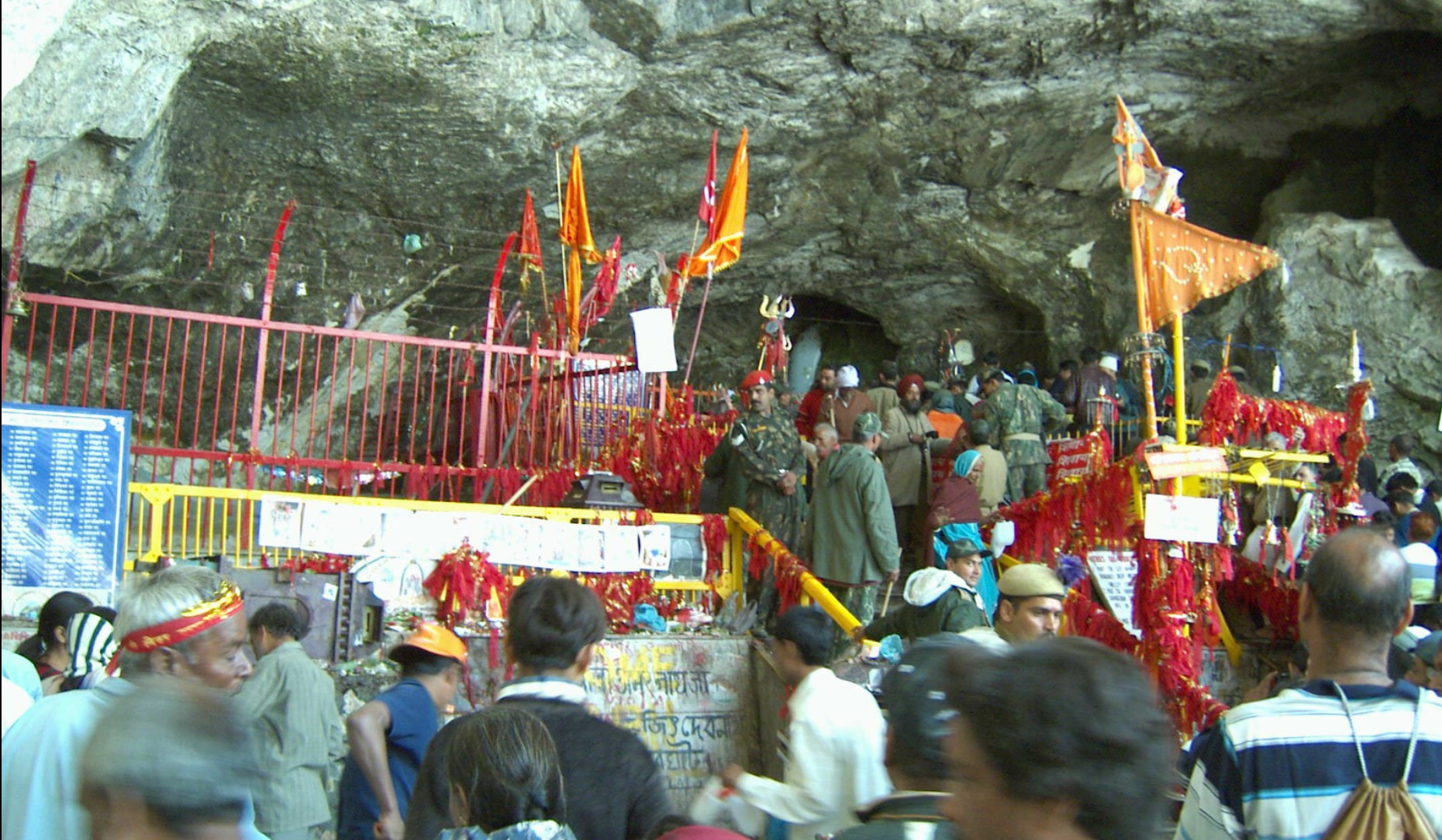
When we finally reached Amarnath, the first surprise was the cave.
I had imagined something much smaller.
Instead, the cavern opened up into a huge natural space.
The queue for darshan was long, but it was moving, so the wait wasn’t as difficult as I had expected.
And then came another surprise.
Photography was allowed inside the cave.
I had carried my camera all the way up, and now I could actually use it.
I photographed the cave and the ice lingam.
Standing there, looking at the naturally formed ice lingam, I felt more awe than anything else.
I had started this journey knowing very little about Amarnath. Now I was standing inside a massive Himalayan cave, surrounded by thousands of pilgrims, looking at something that had drawn people here for generations.
The physical journey had already changed the way I looked at the place.
Back through Baltal
The return route was very different.
The route through Baltal is only about 16 kilometres, considerably shorter than the 32-kilometre approach from Pahalgam, but it is steep.
The ascent and descent were demanding in their own way.
By then, however, we had already completed the longer route to the cave. The knowledge that the pilgrimage was essentially behind us made the return easier mentally, even when the trail itself wasn’t.
Eventually we made our way back towards Srinagar.
One quiet night in Srinagar
After days of walking, crowds, mountains, security checkpoints and transit camps, Srinagar felt almost luxurious.
We stayed one night on a modest houseboat.
It wasn’t particularly luxurious, but after the journey it didn’t need to be.
We spent some time around Dal Lake and visited the Shankaracharya Temple overlooking the city.
It was a short pause before returning to ordinary life.
The next day we headed towards Jammu.
At the station, Giriraj and I went our separate ways.
He boarded his train towards Bangalore.
I boarded mine towards Haridwar.
Nine days after leaving, the journey was over.
What stayed with me
At 29, I didn’t undertake Amarnath because I was searching for a religious experience. I went because a colleague asked me to join him, and because an opportunity to travel somewhere I had never been was difficult to refuse.
But the journey gave me something I carried forward.
A difficult trip is not necessarily an impossible trip.
The trek was hard. The backpack was a mistake. The cold water, the mountain paths, the distance and the altitude all tested us.
But once you decide that you are going to finish, you somehow keep moving.
That was probably the biggest thing Amarnath taught me about travel.
However tough a journey may be, determination can take you to the other side.
And perhaps that is why, even today, when I think back to my first Himalayan pilgrimage, I remember less about the difficulty and more about the feeling of finally standing inside that enormous cave.
At 29, I had simply said yes to a trip.
I didn’t know then that it would become the beginning of many more journeys.